Food is Medicine: Concepts of Eating Beyond Calories and Other Lessons from Ayurveda
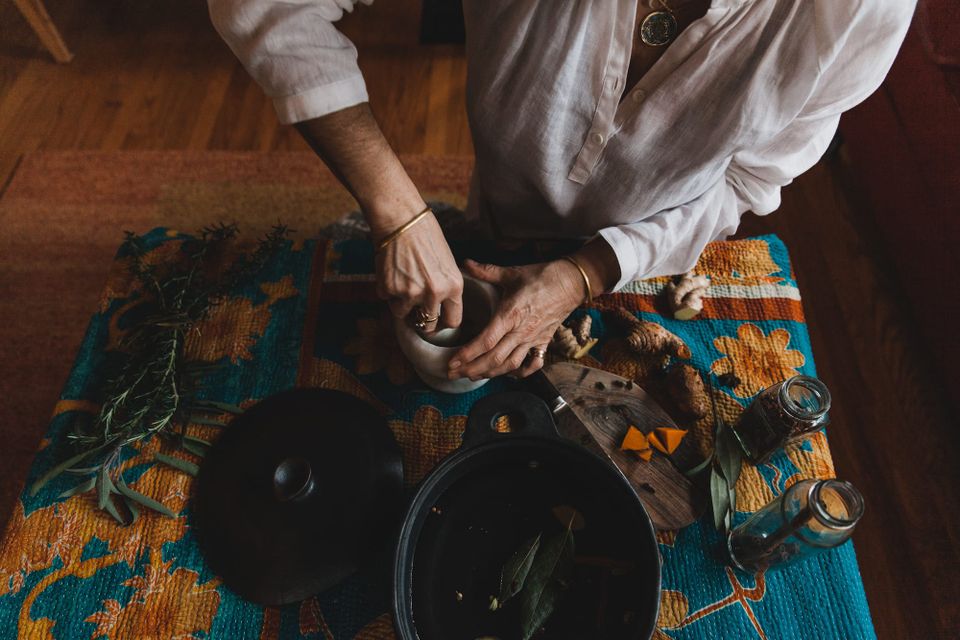
Food Is Medicine — And So Much More
Growing up in central California in the 1970s, natural health wasn't a philosophy in our home — it was simply life. My mother was deeply rooted in a natural way of living: fresh milk from the dairy, transcendental meditation, and a vegetarian diet shaped by the seasonal rhythms of her Italian family. Looking back it seems almost ordinary, but navigating a meatless, seasonal diet in a mid-sized city at that time was genuinely countercultural.
I still smile thinking about the day my sister and I finally convinced my mom to take us to one of those fast food restaurants that everyone was going to. We ordered cheeseburgers — hold the meat, extra lettuce and pickles — and the bewilderment behind the counter was something to behold. The manager herself came out to sort it all out. We walked away victorious, though I still don't understand what all the fuss was about. The french fries, though — those were worth it.
All of it left something lasting in me. Those early experiences — the food, the rhythm, the rootedness — became the seeds of my life's work.
Finding Ayurveda
When I first came to study Ayurveda, I was genuinely moved by how seamlessly its philosophy met what I had been raised with. Here was this ancient wisdom from far across the globe, and it felt less like something new and more like a continuation of threads already woven into my childhood. And yet, as an adult I had made choices that carried me away from that way of living. So it was time — to unlearn a few things, and to go much deeper.
Food is medicine. I heard this early in my introduction to Ayurvedic cooking, and it resonated immediately. It is a philosophy rooted in ancient wisdom that reminds us everything we eat has an impact. A dear teacher once offered us this: "Everything is good, everything is bad. Nothing is good, nothing is bad." A beautiful reminder that eating is not a fixed science but a highly personal and ever-changing experience — shaped by time of day, time of season, and time of life. Nothing is ever rote. It is, at its best, a wonderfully organic and deeply unique conversation.
In Sanskrit, this understanding of time is called kala — and it is central to how Ayurveda understands food as something far more than what simply goes into our mouths.
Time of Day
The body is a natural timepiece — not in a rigid, linear way, but in a fluid and organic one. When we attune to its rhythms, we begin to feel the natural call of genuine hunger, and in that, the right time to eat.
Consider this: when the sun is at its highest and strongest point in the sky, our internal sun — agni, the digestive fire — is also at its peak. It follows beautifully that this is the ideal time for our largest meal, when the body is most capable of receiving and transforming what we give it. Honoring this rhythm regularly strengthens that inner fire and draws us closer to genuine, lasting health. In Ayurveda, agni is revered with the reverence of a Goddess — and so tending to her well is considered wise and sacred action.
Time of Year
Our bodies are remarkable vessels, constantly in conversation with the natural world around us. Ayurveda teaches that seasonal living is one of the most powerful things we can do for our health — and especially for our digestive fire.
When we align ourselves with what Nature is doing outside, something opens inside. We begin to hear our own inner voice more clearly — that quiet, innate knowing of what feels right. I believe that conversation is sacred. It strengthens our natural rhythms, nourishes us at a deep level, and supports the channels and feedback loops that keep us stable, grounded, and truly well.
Time of Life
Aging is natural, and I've come to believe it asks something beautiful of us — to listen more closely, to pay finer attention. That attentiveness becomes one of the great gifts of the middle and later years, a kind of earned wisdom available to those willing to honor it.
Our digestion, like everything else, changes and refines with time. The energy and vitality we once needed in great quantity and regularity may naturally shift as life shifts. The demands on our time and bodies find new rhythms — and adjusting to support that inner fire along the way is simply another form of deep listening, another way of staying in relationship with ourselves.
Nourishment Beyond Food
Ayurveda also reminds us that nourishment arrives from many places beyond the plate. Every day, our mind, body, and spirit are busy ingesting and digesting — ideas, emotions, experiences, conversations. We take in images from screens and difficult exchanges with colleagues. We also feast on heartfelt compliments and love notes written to people we adore.
For better or worse, we are in a constant marriage with ourselves and the world around us — and all of it becomes, in some way, what we are made of. The energy it takes to digest our outer world is real, and it matters. For me, this has translated into a practice of awareness and intention — being thoughtful about how I participate, where I place my energy, and how I receive what the world offers. That shift in awareness changes everything about how it lands in me.
Food is medicine — yes, I believe this to be deeply true. And yet the wisdom Ayurveda continues to unfold reminds me that nourishment is so much wider and richer than any single plate of food. There are so many beautiful ways to strengthen and attune to how we feed ourselves — body, mind, heart, and spirit. That, to me, is the ongoing and ever-deepening gift.